Contact: sales@haomai.net

NEWS
Company News
Practical Guide | Composition of DC System and Maintenance Test of Storage Batteries
I Composition of DC System and Functions of Each Component
- AC Power Distribution Unit
It detects the AC incoming power supply in the DC cabinet and realizes an electrical/mechanical interlocking device for automatic switching or automatic recovery. It is generally installed in the DC charging panel. - Charging Device
It charges the storage batteries and converts AC power into DC power, ensuring that the output DC voltage stays within the required range. It also provides necessary protection for the charging device to guarantee that the technical performance indicators of the DC power supply meet the operation requirements. - Monitoring Device
It manages various parameters and working statuses of the controlled equipment. In the DC system, it is used for system management, realizing the control of charging modules, battery management and remote background monitoring. - Insulation Monitoring Device
It measures and judges the voltage of the control busbar and the insulation resistance of each branch to the ground, and issues an alarm when the values exceed the normal range. The microcomputer insulation monitoring device also has the functions of recording and alarming AC intrusion into DC faults. - Voltage Regulation Device
It ensures that the voltage of the control busbar remains basically unchanged (within the qualified range) when the storage batteries are in states such as floating charge, equalizing charge and discharge. - DC Feeder Unit
Usually referring to the DC feeder cabinet, it is used for the regulation, distribution and detection of the DC power supply of the entire substation, and distributes the DC output power to each output circuit. - Storage Batteries
The voltage grades of battery banks include 220V, 110V, 48V, etc., and the voltage grades of single batteries include 2V, 6V, 12V, etc. Under normal conditions, they are in floating charge standby state. In cases such as low-voltage AC power failure, fault state, large-current startup or short-circuit impact, the storage batteries serve as the DC power supplier for the load. - Battery Inspection Device
It monitors the terminal voltage of a single battery in the operating battery bank, can also measure the ambient temperature and battery current, or measure the internal resistance of a single battery. It can timely detect and predict abnormal conditions of the storage batteries, effectively avoid the occurrence of extreme situations, and ensure the safety and reliability of the DC system.
II Maintenance Test of DC Power Supply System
- According to relevant regulations, the test benchmark cycle of the DC power supply system (excluding storage batteries) is 3 years, and the corresponding maintenance strategy shall be implemented according to the results of state evaluation.
- After the verification charge-discharge test of storage batteries, the verification charge-discharge test shall be carried out once every 2 years. For storage batteries in operation for more than 4 years, the verification charge-discharge test shall be carried out once a year.
- Battery Maintenance Test DeviceAt present, the voltages of battery banks include 220V, 110V, 48V and other grades. The FDT-220/110 DC System Comprehensive Tester is compatible with two battery bank voltage grades of 220V and 110V, and can be designed to be compatible with 48V according to actual needs.
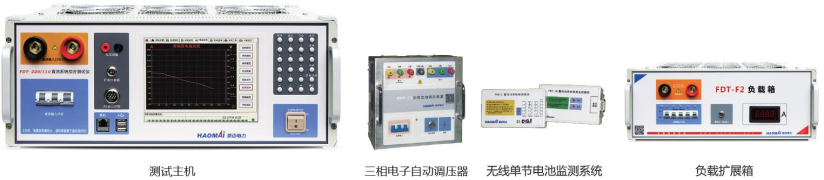
The FDT-220/110 DC System Comprehensive Tester integrates the discharge of battery banks, the ripple coefficient of chargers, and the test of voltage stabilization and current stabilization accuracy characteristics. The wireless main control module is equipped with RS232 and USB communication interfaces, which can communicate and control with computers, tester hosts or other equipment. One wireless communication module can display the charge-discharge curves of 4 single batteries in real time, and can also be designed to display the charge-discharge curves of the entire battery bank. The host can realize a maximum discharge current test of 50A. Considering that the load of some power plants and centralized control centers is relatively large, it can be equipped with a load box according to on-site needs to realize the battery bank test with a maximum discharge current of 180A.
The device also has the charger test function, which can automatically test the voltage stabilization accuracy, current stabilization accuracy, ripple coefficient, as well as voltage and current setting errors of the charging device. It can automatically adjust the AC380V power supply voltage of the charger and the DC load power, and automatically calculate the voltage stabilization accuracy, current stabilization accuracy and ripple coefficient of the charger under various combinations of power supply voltage and load power, meeting the test requirements for the voltage stabilization accuracy, current stabilization accuracy and ripple coefficient of DC110V and DC220V chargers.
24-hours hot line 400-099-8859 technical hot line: 13971234137

Copyright © 2024 All rights Reserved.
备案号:鄂ICP备05010718号-1