Contact: sales@haomai.net

NEWS
Company News
Application of High-power Silicon Rectifier Diodes in Substation Battery Pack Test and Maintenance
The substation DC system supplies power to relay protection devices, circuit breaker operations and various signal circuits. The normal operation of the DC system is related to whether the relay protection and circuit breakers can operate correctly, and affects the safe operation of the substation and even the entire power grid. The battery pack is an important part of the DC system. Conducting verification charge-discharge tests and replacing batteries are important daily maintenance items for the substation DC system. The following briefly introduces the application of a type of high-power spiral silicon rectifier diode in DC maintenance work.
1. On-line 50% Capacity Verification Discharge Test for Substation Battery Packs
Power plants or substations equipped with only one battery pack cannot perform full-capacity verification discharge tests after being taken out of operation, so a half-capacity discharge test method can be adopted for evaluation. After discharging, constant-current voltage-limited charging, constant-voltage charging and floating charging should be immediately performed at 1n current. If necessary, the discharge-charging cycle can be repeated 2–3 times, or underperforming batteries can be individually activated to restore the capacity of the battery pack.
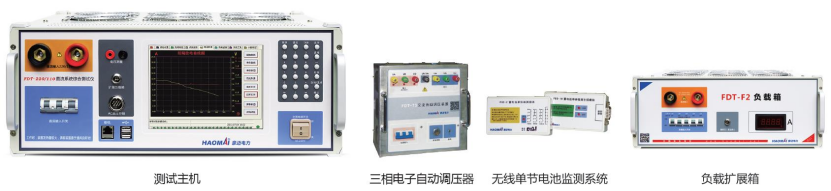
High-power rectifier diodes can be used as safety devices in the 50% capacity verification discharge test. With the function of one-way check, the diodes prevent the charging device from charging the battery pack during the discharging process, making the charging device only supply power to the continuous load while the battery pack remains in hot standby mode. At this time, the FDT-220/110 DC System Comprehensive Tester can be used to carry out the on-line 50% capacity discharge test for the battery pack, completing the on-line discharge test under safe operation conditions.

△ Wiring Mode for Verification Discharge Test of Substation Configured with Single Battery Pack
In the temporary wiring mode for test discharge shown in the figure, remove the positive fuse of the battery pack, and replace the position of the positive fuse with the positive and negative poles of the high-power diode (the anode of the diode is connected to the lower end of the fuse, and the cathode is connected to the upper end of the fuse—note that the polarity cannot be reversed). Connect the total positive and negative poles of the battery pack to the FDT-220/110 DC System Comprehensive Tester. During the battery pack discharging process, due to the one-way check function of the diode, the charging module on the DC panel cannot charge the battery pack. If the AC input power supply of the DC panel is cut off or the high-frequency charging module fails during the test, the battery pack under test can still supply power to the DC feeder panel, avoiding DC power supply voltage loss during the charge-discharge test.
2. Application of High-power Diodes in Hot Replacement of Single Battery Cells
When a single battery cell in an operating battery pack is found unqualified, directly disconnecting the battery pack to replace the faulty cell without safety protection measures may cause AC voltage loss and further lead to DC bus voltage loss. The one-way check characteristic of high-power diodes can play a safety protection role in this scenario. For hot replacement of unqualified battery cells, the safety device is required to have clear positive and negative polarity marks, be able to supply power to emergency loads, be compatible with battery packs of multiple voltage levels, and require no external power supply.
1) Preparation Before Replacement
Go through the relevant procedures in accordance with on-site work requirements, take corresponding safety measures, and obtain the approval of the operation unit before maintenance personnel can enter the site to carry out work.
2) Replacement and Test Wiring
Determine the polarity of the battery cell to be replaced and operate in sequence according to the device user manual. Generally, fix the black clip on the positive pole of the adjacent battery connected to the negative pole of the battery to be replaced, and fix the red clip on the negative pole of the adjacent battery connected to the positive pole of the battery to be replaced. After confirming that the wiring is correct, remove the battery to be replaced, install a new battery cell, and restore the battery connecting bars.

△ Wiring Diagram 1 for Hot Replacement of Single Battery Cells
3) Testing Wiring and Steps for Devices with Display Function
Fix the black clip on the positive pole of the adjacent battery connected to the negative pole of the battery to be replaced, connect the green clip to the positive pole of the battery to be replaced. The voltage of the battery cell displayed on the device indicates correct wiring. Fix the red clip on the negative pole of the adjacent battery connected to the positive pole of the battery to be replaced. After the bridging indicator light is on and the wiring is confirmed correct, remove the battery to be replaced, install a new battery cell, and restore the battery connecting bars. Remove the red clip and connect the green clip to the positive pole of the new battery cell. The device will display the voltage of the new battery cell.

△ Wiring Diagram 2 for Hot Replacement of Single Battery Cells
4) Remove Test Wiring and Restore the Site
After confirming that the battery connecting bars are in good contact and firmly connected, remove the black clip and red clip (or green clip) to complete the hot replacement of the battery cell. Go through the relevant procedures in accordance with the on-site work requirements of the operation unit and conclude the work.
24-hours hot line 400-099-8859 technical hot line: 13971234137

Copyright © 2024 All rights Reserved.
备案号:鄂ICP备05010718号-1