The substation DC system is mainly composed of DC charging panels, DC feeder panels, battery banks and battery panels. It supplies DC power for relay protection devices, measurement and control devices, automation devices, circuit breaker opening and closing operations, emergency lighting, uninterruptible power supplies and various signal circuits. The reliability of the DC system is the guarantee for the safe operation of substations.
With the increase in the operation life of the substation DC system, internal components age, leading to frequent faults of the DC system and bringing great pressure to operation and maintenance. In addition, equipment manufacturers upgrade and replace their products, resulting in an increasing shortage of spare parts, making the demand for system renovation urgent.
Difficulties in the Construction of DC System Renovation
- At present, the DC system of some substations adopts ring network power supply, and small busbars are installed on the top of protection panels. The DC system renovation requires converting the ring network power supply to radial power supply and removing the DC small busbars on the panel top.
- The limited scale in the early design has led to crowded protection panels and a large number of cables in the main control room, with few and narrow cable trenches. Only one side of the bottom of some panels has reserved holes for cable entry and exit, which increases the difficulty of threading new cables into the panels.

△ The holes of the protection panel are blocked by cables, and the construction personnel lie in the cable trench to pull the cables

△ The DC feeder panel is sandwiched between two protection panels
- The installation technology is uneven in the early wiring. Many cables have no hanging tags, and the wire number marking is non-standard. DC power is randomly jumper-connected between protection panels, making it difficult to check the secondary circuit.
- To remove the original DC feeder panel, all DC feeder loads must be transferred to the temporary feeder panel. Improper operation in this process may lead to a series of accidents such as DC power short circuit, DC bus voltage loss, protection device power failure and switch maloperation, which places extremely high requirements on the construction personnel's operations such as wire checking, wiring and disconnection. Before carrying out the transfer work, identify the equipotential terminals that can be connected in parallel or add equipotential terminals by increasing voltage terminals and connecting pieces, then lay temporary cables to connect to the equipotential terminals to ensure that the equipment or circuits to be transferred do not lose power. Severe accidents will occur if the DC voltage polarity is wrong, the live wire core is not wrapped firmly and touches the panel, or two wire cores are short-circuited. Construction personnel are required to be extremely careful and operate in strict accordance with the procedures and specifications.

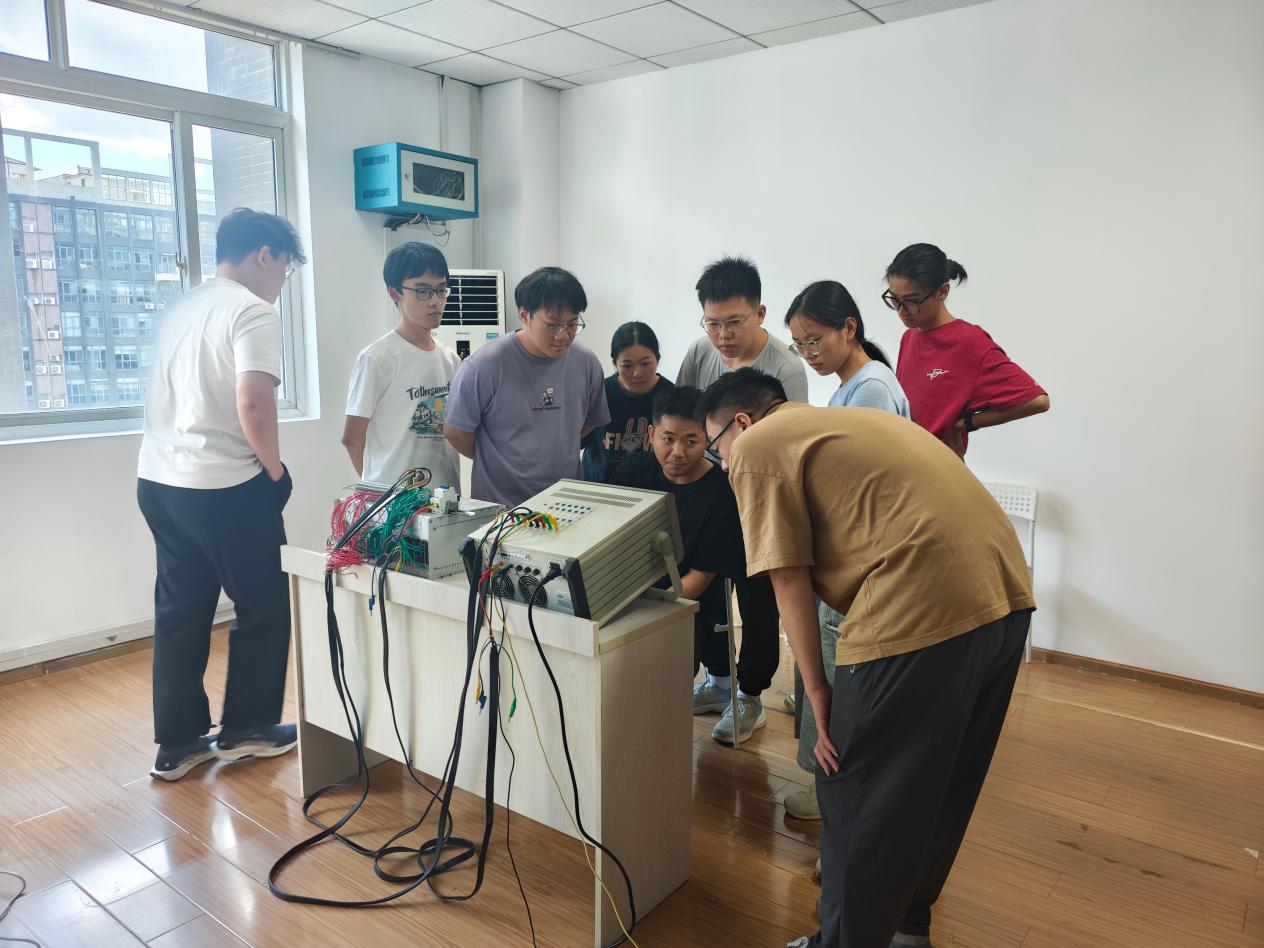
△ The on-site person in charge emphasizes the operation content, work ticket information, safety risks and control measures
- The vibration generated during panel removal may cause maloperation of the relay contacts of adjacent protection panels. Under normal circumstances, there are connecting plate screws between the DC panel and adjacent panels, and welding points between the panel base and channel steel. When removing the panel, it is necessary to control the force and the tilting range of the panel to minimize the vibration.
- There is no ring network formed between the I/II protection power supply and I/II control power supply in the 10kV distribution room, nor is there a ring network knife switch for switching on and off. It is necessary to find out which interval's switch cabinet panel top the protection power supply and control power supply correspond to, and the DC small busbar on the panel top is related to whether the protection power supply and control power supply of the 10kV distribution room lose power during transfer. In the past, explosion accidents of 10kV switch cabinets in substations may be caused by short circuits due to small animals entering, or switch refusal to operate or poor switch quality. Therefore, the construction time in the 10kV distribution room should be minimized as much as possible.

△ The GD label is the DC power input terminal block of the protection panel. Add one voltage terminal, and short-circuit GD1 with GD2 and GD5 with GD6
- Both sides of the DC charging panel (or feeder panel) are protection panels and are connected across the panel top small busbars. When the panel is moved back, the top of the panel may touch the small busbars, causing short circuit and grounding of the panel top small busbars. Therefore, before moving the panel back, it is necessary to transfer the DC small busbars and AC small busbars (i.e., protection voltage) on the panel top, and then remove the panel top small busbars.

△ Lay cables on the panel top, adopt cable transition flexible connection to the panel top small busbars, and then remove the panel top small busbars
In addition, the DC system renovation project also involves many other links: compiling and approving the three measures and one plan for construction, three-level safety and technical disclosure, submitting and approving construction start materials, handling work tickets and construction operation tickets, etc.; applying for and transferring cables, panels and batteries; completing the full check charging and discharging test of battery banks, battery internal resistance test, charger charging characteristic test and insulation test; coordinating the DC system manufacturer to conduct on-site overall commissioning, coordinating the background manufacturer to make point lists according to DC protocols and submit them to the automation team for review, finally resetting the DC system alarm signals, messages and light word boards, and cooperating with operation and maintenance personnel to complete the point checking of the centralized control center.

△ Completion of DC system renovation